From Proof of Concept to Production AI
The demo worked. Everyone was impressed. Now comes the part that actually decides whether the project succeeds — and it's mostly not about the model.
A proof of concept proves that an idea can work. Production proves that it can be operated — safely, affordably, and by a team that isn't you. The distance between those two is where most enterprise AI projects stall, and it's rarely because the model wasn't good enough.
The demo hides the hard part
A POC is optimized to impress in a controlled setting. It runs on clean data, a friendly question, and a forgiving audience. None of the things that make production hard are visible in that room:
- Evaluation. How do you know it's still good next month, on data you haven't seen?
- Monitoring. How do you detect drift before your users do?
- Security & governance. Who can see what, and how is every decision logged?
- Cost at scale. What does this cost at 100× the demo's volume?
- Human-in-the-loop. Where does a person stay in control of consequential actions?
Make the gap visible
The most useful thing I do at this stage is refuse to let “almost done” stay vague. I turn the remaining work into an explicit checklist with the customer, so the last stretch is planned rather than assumed. A POC with a 90%-impressive demo is often less than halfway to production — and naming that honestly builds more trust than optimism does.
Treat AI like the production software it is
Non-deterministic systems need more operational rigor than deterministic ones, not less. Evaluation sets, monitoring, audit logging, and clear failure modes aren't bureaucracy — they're what let you put the thing in front of real customers and sleep at night. ResolveIQ was built specifically to show that gap end to end.
The goal was never a great demo. It was a system a team can confidently own after I'm gone.
Related projects
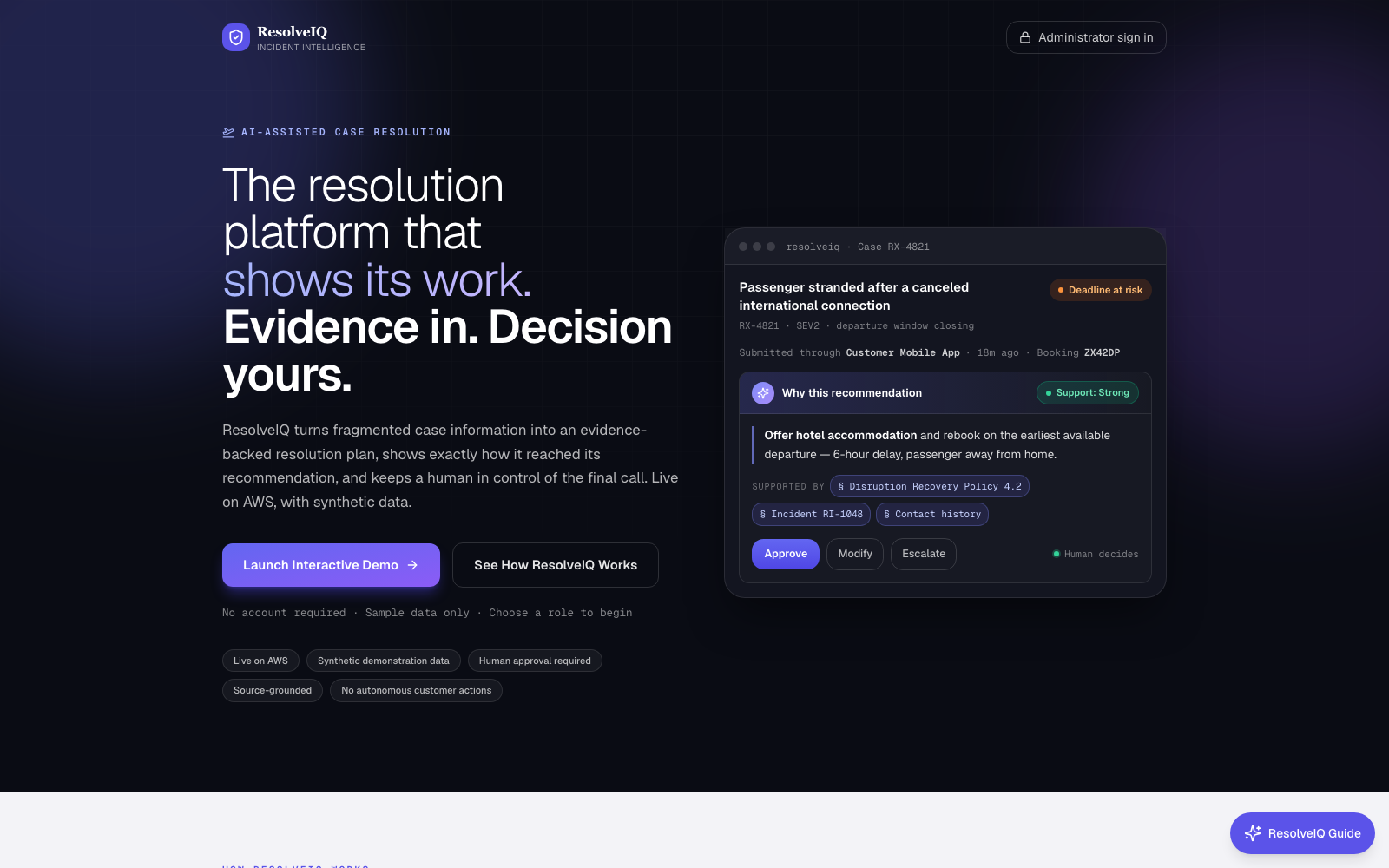
ResolveIQ — Enterprise AI Case Resolution
An AI platform that turns fragmented, high-risk support cases into cited, evidence-backed resolution recommendations, and keeps a human in control of every decision.
Problem
Enterprise support teams sit on scattered case data and tribal knowledge, and most AI demos ignore the governance reality of acting on a real customer account.